PQ and HLG Explained
Once video starts encoding HDR brightness, the next question is obvious: how?
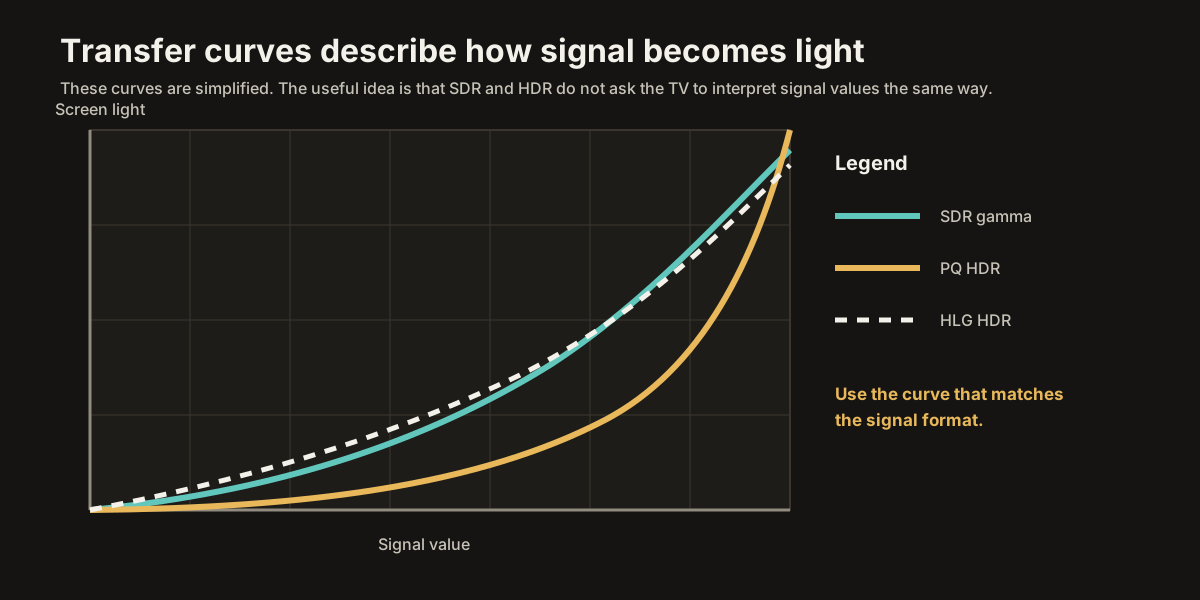
A digital signal is still just numbers. A display still has to turn those numbers into light. But HDR changes what the numbers mean. In SDR, the signal is mostly relative: this value is this far up the range between black and white. In HDR, especially PQ HDR, the signal can refer to absolute luminance values - real brightness levels, expressed in nits.
That requires a different kind of curve.
SDR used gamma, a transfer-function system shaped partly by human vision and partly by the accidental physics of CRT displays. HDR needed something more deliberate. It needed curves designed for a much wider brightness range, modern displays, and new distribution problems.
Two curves became the important ones.
One is PQ, the Perceptual Quantizer. It is the curve behind HDR10, HDR10+, Dolby Vision, and most HDR movies, shows, discs, and streaming video.
The other is HLG, Hybrid Log-Gamma. It was built for broadcast, where one signal may need to work across a wide mix of HDR and SDR-compatible receivers.
They are both HDR transfer functions. They both exist because gamma was not enough. But they solve different problems.
This piece is about what each curve does, why each one exists, and where you are likely to encounter them.
That difference also shapes how HDR formats package metadata and how real displays handle HDR brightness limits.
The perception problem
Before the curves themselves, there is one piece of vision science worth knowing.
Human vision does not notice brightness differences evenly. At some luminance levels, the eye can detect very small changes. At others, the change has to be larger before it becomes visible. The threshold depends on the brightness of the surrounding image, the adaptation state of the eye, and other viewing conditions.
Peter Barten's work on human contrast sensitivity became an important reference point for HDR engineering. His model helps answer a practical question: at a given luminance, how large does a brightness step have to be before a viewer can see it?
For video encoding, that question matters enormously.
If the steps between adjacent code values are larger than the eye's threshold, viewers may see banding or contouring. If the steps are far smaller than the eye can see, the signal is wasting precision. The ideal transfer function spends code values where vision needs them and saves code values where vision is less sensitive.
That was manageable in SDR because the brightness range was modest. Gamma-based SDR encoding works reasonably well across the old 100-nit reference world.
HDR is different.
Stretch a traditional gamma curve across a range up to 1,000, 4,000, or 10,000 nits, and it no longer spends bits efficiently. Too much precision goes where it is not needed. Not enough precision goes where the eye can notice errors. Banding becomes a much bigger risk.
HDR needed a transfer function built for human perception across a much larger luminance range.
That is where PQ comes from.
PQ
PQ stands for Perceptual Quantizer.
It was developed by Dolby and standardized as SMPTE ST 2084. It was later incorporated into BT.2100 as one of the two HDR-TV transfer-function systems. PQ was designed for a very specific job: map digital code values to absolute display luminance levels in a way that follows human brightness perception across a very large range.
That range runs up to 10,000 nits.
That does not mean your TV can show 10,000 nits. It does not mean most HDR movies use 10,000 nits. It means the PQ system has enough headroom to describe brightness values up to that ceiling.
The important difference from SDR gamma is this: PQ is absolute.
In a PQ system, a signal value maps to a defined display luminance. The curve does not simply say "put this pixel halfway up whatever brightness range the TV has." It says, in effect, "this pixel corresponds to this much light."
That is the architectural leap.
A PQ signal can ask for a 400-nit highlight, a 1,000-nit highlight, or a 4,000-nit highlight. If the TV can reproduce that luminance, it can show it directly. If it cannot, it has to tone-map the signal into its own capabilities.
This is why PQ is so central to HDR movies and streaming video. It gives the mastering process a precise luminance language. The colorist is no longer grading only in relative video levels. They are working against a display with known luminance behavior, and the signal can carry those brightness relationships forward.
PQ is not a simple power curve like gamma. The math is more complex because it was built to match perceptual thresholds across a wide range of brightness. The equation matters to engineers and standards writers. For viewers, the practical result matters more: PQ is far more efficient than stretching SDR gamma over HDR luminance levels.
There is one important nuance. PQ can be used with 10-bit or 12-bit systems, but 12-bit gives more precision. HDR10 uses 10-bit PQ. Dolby Vision can use 12-bit internal precision, depending on the workflow and delivery path. Ten-bit PQ is the common consumer HDR baseline and is much better suited to HDR than 8-bit SDR-style encoding, but it is not magic. Bad compression, poor processing, weak gradients, or aggressive tone mapping can still reveal banding.
PQ has another tradeoff: it is not friendly to SDR-only interpretation.
If a PQ signal is displayed by a device that treats it like ordinary SDR gamma, the image looks wrong - often dark, flat, washed out, or strangely low in contrast. That is not a bug in PQ. It is a consequence of its purpose. PQ assumes the playback chain knows it is receiving PQ HDR.
That is acceptable for discs, streaming apps, game consoles, and other controlled playback paths. The source can usually detect whether the display supports HDR and send the right format.
Broadcast had a harder problem.
HLG
HLG stands for Hybrid Log-Gamma.
It was developed by the BBC and NHK for HDR broadcasting. The problem it solves is different from the one PQ solves.
A streaming service can send one version of a program to an HDR TV and another to an SDR TV. A UHD Blu-ray player can negotiate with the display before playback. A game console can be configured for the screen it is connected to.
A broadcaster may not have that luxury.
A live sports event, news program, or over-the-air broadcast may need to go out as one signal to a huge range of receivers. Some viewers have HDR TVs. Some have SDR TVs. Some equipment in the chain may be newer; some may be older. A broadcaster needs a signal that degrades gracefully.
PQ is not ideal for that. If an SDR system interprets PQ incorrectly, the result can look broken.
HLG was designed to be more forgiving.
The word "hybrid" describes the curve. The lower part behaves more like a conventional gamma-style signal. The upper part transitions into a logarithmic curve to carry extended highlights. In simple terms: HLG keeps the lower and middle portions of the image closer to the world SDR systems understand, while reserving extra range for HDR highlights.
This makes HLG useful for broadcast and live production.
An HLG signal is not absolute in the same way PQ is. HLG is relative and scene-referred. It does not assign each code value to a fixed nit value the way PQ does. Instead, the display adapts the signal to its own peak brightness and viewing assumptions.
That makes HLG less precise than PQ for carefully mastered film and television. A colorist using PQ can work with more specific display luminance targets. HLG gives up some of that exactness in exchange for flexibility and compatibility.
That tradeoff makes sense for broadcast.
A live HDR football match, a tennis tournament, a concert, or a news event may need to be produced once and delivered widely. HLG allows HDR-capable displays to show an HDR version of the signal while SDR-compatible systems can still get a watchable picture, provided the colorimetry and device support are handled correctly.
There is an important caveat: HLG is not a magic guarantee that any old SDR TV will show a perfect picture. HLG HDR is normally part of a BT.2100 / BT.2020-style HDR system. A very old SDR-only Rec.709 display may not handle the color or signal path correctly. The compatibility is best understood as broadcast-friendly and SDR-compatible within appropriate UHD/HDR-aware systems, not as "perfect on every television ever made."
Still, the goal is clear.
PQ optimizes for precision.
HLG optimizes for graceful distribution.
Where you encounter each
In everyday home viewing, PQ is the HDR curve you are most likely to see.
HDR10 uses PQ. HDR10+ uses PQ. Dolby Vision uses PQ. Most HDR movies and series on streaming services use PQ. UHD Blu-ray uses PQ. HDR games are usually delivered through PQ-based HDR10 or Dolby Vision paths, depending on platform and display support.
The differences among HDR10, HDR10+, and Dolby Vision are not mainly about the basic brightness curve. They are about metadata, tone-mapping guidance, dynamic scene information, licensing, and how much help the display gets in adapting the master to its own capabilities. Underneath, they are all built around PQ.
HLG shows up mostly in broadcast and broadcast-adjacent contexts.
Live HDR sports, public-service broadcaster trials, some satellite and terrestrial HDR broadcasts, some camera workflows, and some uploaded HDR video use HLG. It is especially useful where the signal has to move through a production or delivery chain that benefits from relative encoding and broad compatibility.
Modern HDR-capable TVs usually support both PQ and HLG. The source or broadcast signal tells the TV which transfer function is being used, and the TV switches into the appropriate HDR mode. Most of the time, viewers do not need to choose between them manually.
When something goes wrong, the symptoms are obvious. A PQ image interpreted incorrectly may look too dark or flat. An HLG signal handled incorrectly may look washed out, clipped, oddly colored, or not HDR at all. The usual cause is a mismatch somewhere in the chain: source settings, HDMI format support, app behavior, broadcast handling, passthrough through a receiver or soundbar, or a TV setting that forces the wrong mode.
The right fix is not to change the artistic settings by eye. It is to make sure the source, cable, receiver, and TV are all correctly passing the format.
PQ versus HLG
The easiest way to understand the two curves is to compare their priorities.
PQ is absolute. HLG is relative.
PQ is display-referred. HLG is scene-referred.
PQ is best suited to mastered content where the playback chain can be managed. HLG is best suited to broadcast and live production where one signal may need to serve many display types.
PQ gives the colorist a more precise luminance language. HLG gives broadcasters a more flexible delivery language.
PQ usually needs tone mapping when the display cannot hit the brightness requested by the signal. HLG is designed to scale more naturally to different display peaks, though real TVs may still apply their own processing.
PQ is less compatible with SDR interpretation. HLG is more compatible, though not perfectly universal.
Neither curve is "better" in all situations. They solve different problems.
For a movie mastered for streaming or disc, PQ is usually the right tool. The content can be graded carefully. Metadata can be included. The playback device can know whether the TV supports HDR. The goal is to preserve creative intent as accurately as the display allows.
For a live broadcast, HLG is often the more practical tool. The signal can move through a broadcast chain and reach a mixed audience without requiring a separate SDR and HDR version in every case. The goal is not perfect precision on every display. The goal is a robust signal that works acceptably across many displays.
That is why both exist.
Why your TV needs both
From the viewer's perspective, PQ and HLG are usually invisible. You press play, the TV switches modes, and the image appears.
But understanding the curves explains a lot of HDR behavior.
It explains why HDR sometimes looks wrong when a device is misconfigured. The TV may be applying the wrong transfer function.
It explains why HDR10, HDR10+, and Dolby Vision feel related. They share PQ underneath.
It explains why live HDR broadcasts often use HLG instead of HDR10. Broadcast compatibility matters more than per-scene metadata.
It explains why tone mapping is unavoidable. PQ can ask for absolute brightness levels many TVs cannot produce.
It explains why HDR is not just "turning up brightness." The entire relationship between signal values and display light has changed.
Where this leaves us
Two curves, two purposes.
PQ is the precision curve. It maps signal values to absolute luminance and underlies most mastered HDR content: HDR10, HDR10+, Dolby Vision, UHD Blu-ray, streaming HDR, and many HDR games.
HLG is the broadcast curve. It uses a hybrid gamma/log shape and a relative signal model to make HDR easier to produce and distribute across mixed display environments.
Both are part of BT.2100. Both are HDR. Both replace SDR gamma for their intended uses. And both express the same larger shift: video is no longer confined to SDR's relative 100-nit world.
But encoding brightness is only the beginning.
A PQ signal can ask for 4,000 nits. Your TV may top out at 800. An HLG broadcast may scale differently across two displays. A scene may contain highlights that exceed what the panel can show, colors that exceed its gamut, or both at once.
The next big question is what the TV does when the signal asks for more than the hardware can deliver.
That question is tone mapping.
For now, the takeaway is simple:
PQ is the HDR curve for precision.
HLG is the HDR curve for broadcast flexibility.
Your TV needs to understand both, because HDR is not one curve. It is a family of systems built around the same new idea: brightness has become part of the signal's meaning.
Next: TV Bit Depth Explained Move from HDR transfer functions into the signal precision needed to keep gradients smooth.